
.png)
Rice Flour vs Glutinous Rice Flour: The Mix-Up That Can Ruin Korean Recipes

Updated: May 16
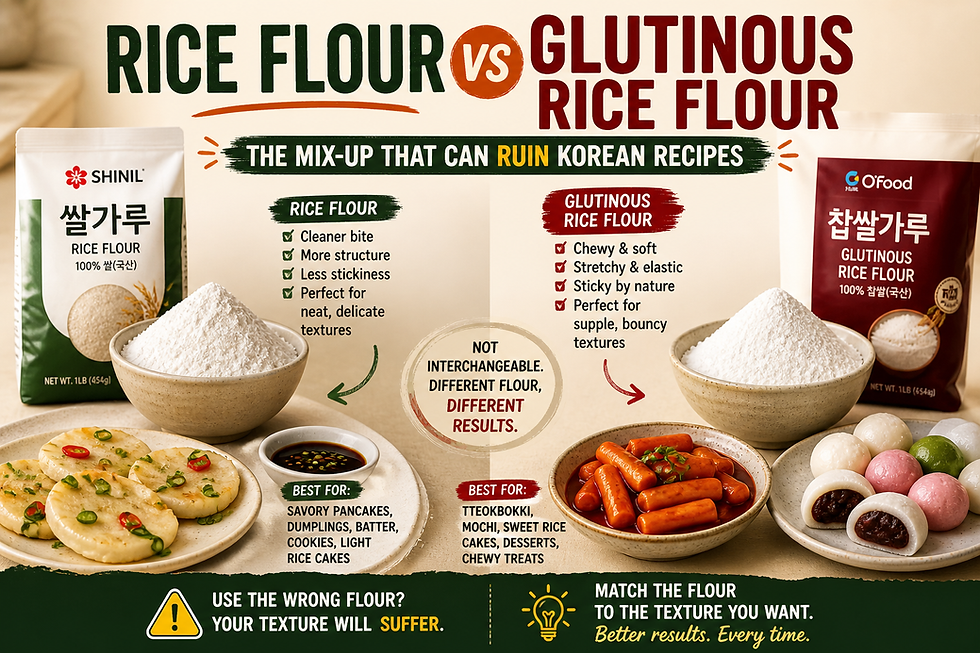
This is the kind of mistake that makes you question a recipe that was never the problem.
The dough looks right until you touch it. The batter starts dragging instead of flowing. The rice cake comes out looking respectable, then lands either weirdly gummy or disappointingly dead on the bite. You think maybe you steamed it too long. Maybe you added too much water. Maybe your measurements slipped.
Then you look at the bag.
Rice flour.
Or glutinous rice flour.
Wrong one.
That swap ruins Korean recipes in a very specific way because these flours are not close cousins pretending to be different on the label. They go in completely different texture directions the minute water and heat get involved.
One gives you a cleaner, firmer, less clingy bite.
The other gives you stretch, chew, softness, and that unmistakable sticky pull certain Korean sweets and rice cakes absolutely depend on.
They do not fix the same problem. They do not rescue each other. And when a Korean recipe goes off, this mix-up is often the first thing worth blaming.
TL;DR
Rice flour and glutinous rice flour are not interchangeable in Korean recipes. Plain rice flour usually works better when you want a cleaner bite, more structure, and less stickiness. Glutinous rice flour works better when the whole point is chew, softness, stretch, or that sticky, elastic texture you get in many Korean sweets and chewy rice cakes. If the recipe should feel neat and restrained, plain rice flour usually makes more sense. If it should feel supple, bouncy, and a little clingy, glutinous rice flour is usually the right move.
This is not really a flour problem. It is a texture problem.
That is the easiest way to stop getting confused.
A lot of people shop by the word rice and assume they are staying in the same neighborhood. They are not.
Plain rice flour is for recipes that should feel cleaner on the bite. Less pull. Less stick. More shape. It gives you the kind of texture that stays tender without turning into chew for chew’s sake.
Glutinous rice flour is for recipes where chew is the reward. It is what gives certain Korean desserts and chewy rice cakes that soft resistance people are actually craving. Not crumbly. Not cakey. Not fluffy. Chewy.
Once you think in texture instead of labels, the whole category gets easier.
Why this mix-up happens so often in Korean cooking
Because the naming is genuinely unhelpful.
“Glutinous” sounds like it should mean gluten. It does not. “Sweet rice flour” sounds like it should contain sugar. It does not. “Rice flour” sounds broad enough to include everything made from rice. It absolutely does not.
Then Korean recipe names add another layer. A recipe may use a Korean term like chapssal-garu or mepssal-garu and assume you already know which texture family that points to. If you do not, the wrong bag can look close enough to be harmless.
It is not harmless.
This is why some Korean recipes fail in a frustratingly almost-right way. They steam. They set. They brown a little. They look plausible. Then you bite in and the whole point of the recipe is missing.
👉 For a kimchi-specific look at rice paste, seasoning cling, gochugaru hydration, and when sweet rice flour actually matters, use the sweet rice flour for kimchi guide.
What plain rice flour does better
Plain rice flour is the flour for restraint.
It is what you want when the recipe should hold together cleanly instead of stretching back at you. It works better for batters or doughs that need a little structure, for rice-cake styles that should feel tender without turning mochi-like, and for any recipe where too much stickiness would make the whole thing feel heavy or muddy.
This is also the flour that makes sense when you want the rest of the recipe to stay in focus. Fillings. Broth. Crisp edges. Toppings. Plain rice flour tends to cooperate instead of dominate.
If you accidentally use glutinous rice flour here, the texture usually goes wrong in a familiar way. The batter gets oddly draggy. The bite gets sticky when it should feel light. What was supposed to seem tidy and clean starts feeling gummy around the edges.
That is where a product like Raw Nature Rice Powder makes sense. It fits the plain-rice-flour side of Korean cooking, where you want rice character and softness without that extra elastic pull.
What glutinous rice flour does better
Glutinous rice flour is not a backup version of rice flour.
It is the whole reason some Korean recipes feel right.
When a rice cake or dessert is supposed to bend a little, stay soft, and give you that gentle chew that keeps going for a second after the bite, this is usually the flour doing the heavy lifting. This is the flour for recipes where softness alone is not enough. You need bounce. You need stretch. You need that slightly sticky, satisfying resistance.
Use plain rice flour in those recipes and the result often feels emotionally incorrect.
Not just wrong. Incorrect.
The shape may look decent. The color may even come out close. But the center eats dry, sandy, or strangely flat, like the recipe showed up without its personality.
That is why a product like Jeonwon Sweet Rice Powder matters. “Sweet rice” is the clue here. That is the glutinous one, the chewy one, the one you want when the recipe is supposed to feel soft and elastic instead of merely made.
The wrong swap usually ruins Korean recipes in one of two ways
👉 The recipe goes gummy when it was supposed to stay cleaner
This is the classic glutinous-rice-flour-in-the-wrong-place problem.
Instead of a neat bite, you get cling. Instead of lightness, you get drag. The texture lingers in a way the recipe never asked for.
This is especially annoying in savory recipes or any batter where crispness, shape, or a cleaner finish mattered more than chew.
👉 The recipe turns dry, crumbly, or weirdly lifeless when it was supposed to be chewy
This is the plain-rice-flour-in-the-wrong-place problem.
The recipe may still look close enough to make you hopeful. Then you bite it and realize the chew never arrived. What should have felt plush and stretchy feels short, dry, or faintly chalky instead.
This is the more heartbreaking mistake because the recipe often fails politely.
Nothing obviously collapses.
It just never becomes what you were trying to make.
Which one should you use for Korean rice cakes?
This is where people want one easy answer, and the useful answer is still texture.
If the rice cake should be chewy, soft, sticky, or dessert-like, glutinous rice flour is usually the better choice.
If it should be firmer, cleaner, less sticky, or more structured, plain rice flour usually makes more sense.
That is not every tteok recipe on earth reduced to one rule. It is just the fastest honest grocery-store rule for real people.
You are usually not choosing between two similar outcomes.
You are choosing between chew and clarity.
A few Korean-recipe clues that matter more than people think
If a recipe is aiming for that soft, stretchy, almost mochi-like satisfaction, treat that as a glutinous-rice-flour clue.
If it is aiming for a cleaner bite, a more sliceable shape, or a texture that should stay tender without getting sticky, treat that as a plain-rice-flour clue.
If a finished Korean dessert or rice cake is supposed to feel like it gives back a little when you bite it, plain rice flour will often leave it too stiff or too dull.
If it is supposed to feel neat and composed rather than clingy, glutinous rice flour can make the texture feel louder than the recipe intended.
That is why this swap matters so much. In Korean cooking, texture is not decoration. Texture is often the dish.
The easiest way to stop making this mistake
Do not shop by the front label alone.
Shop by the bite you want.
If the recipe should feel stretchy, soft, chewy, and a little sticky, look for glutinous rice flour or sweet rice flour.
If the recipe should feel cleaner, firmer, less sticky, or more quietly structured, look for plain rice flour.
That mental shortcut is better than trying to memorize every naming variation when you are standing in the aisle half-distracted.
Ask one question:
What should this recipe feel like in my mouth?
That question will get you to the right bag faster than the word rice ever will.
👉 Browse our [Flour, Powder & Baking category] for more options.
Final answer
Rice flour and glutinous rice flour are not minor variations in Korean cooking.
They are texture decisions.
Plain rice flour is for recipes that need structure, a cleaner bite, and less stickiness.
Glutinous rice flour is for recipes that need chew, softness, stretch, and that sticky, elastic feel certain Korean sweets and rice cakes are built around.
So if a Korean recipe came out gummy, dense, crumbly, or strangely lifeless, do not start by doubting the recipe.
Check the flour.
A lot of Korean recipes do not fail because the cook was careless.
They fail because the wrong bag came home.
Related posts to read next
FAQ
Is rice flour the same as glutinous rice flour?
No. They come from different kinds of rice and behave very differently in Korean cooking. Plain rice flour gives a cleaner, less sticky result. Glutinous rice flour gives more chew, stretch, and cling.
Does glutinous rice flour have gluten?
No. The name is confusing, but glutinous rice flour does not contain gluten. In this context, “glutinous” refers to the sticky texture, not wheat gluten.
What is sweet rice flour in Korean recipes?
Sweet rice flour is another common name for glutinous rice flour. It is the flour you use when the recipe should feel chewy, soft, and slightly elastic.
Which flour is better for Korean rice cakes?
It depends on the texture you want. Chewy, sticky, dessert-like rice cakes usually need glutinous rice flour. Firmer, cleaner, less sticky rice cakes usually make more sense with plain rice flour.
Why did my Korean recipe turn gummy?
One common reason is using glutinous rice flour in a recipe that needed plain rice flour. That can make the texture too sticky, stretchy, or heavy for the dish.
Why did my rice cake turn dry instead of chewy?
That often happens when plain rice flour gets used where glutinous rice flour was supposed to be. The recipe may still look fine, but the chew and softness never really show up.
What is the easiest way to choose the right one?
Ignore the label first and think about the bite. If you want chew, softness, and stretch, choose glutinous rice flour. If you want cleaner structure and less stickiness, choose plain rice flour.


Comments