
.png)
The Cold Noodle Condiments That Actually Matter: Mustard, Vinegar, Bibim Sauce, and More

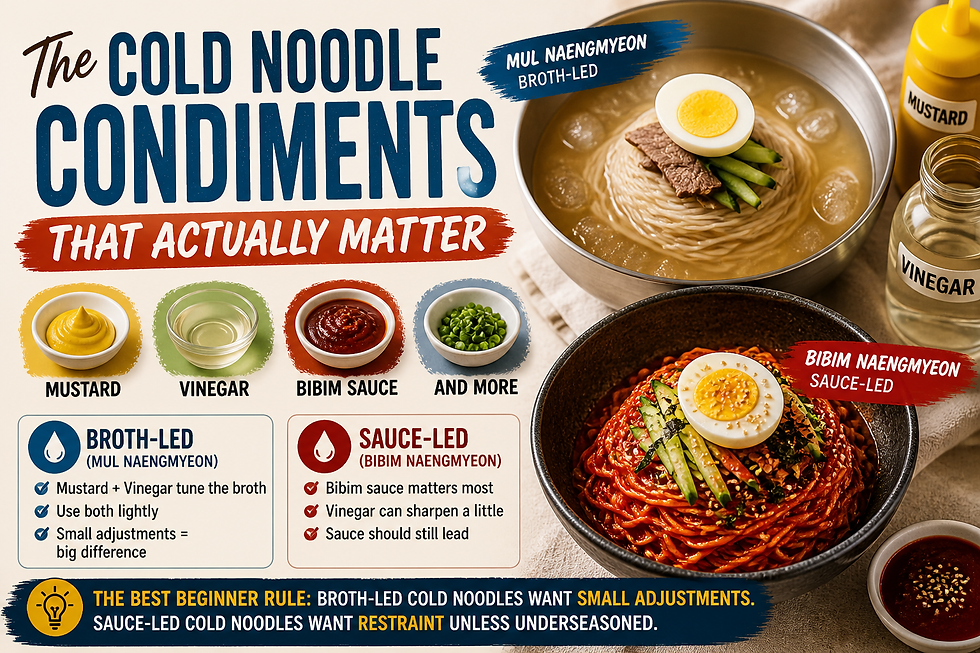
Cold noodles get ruined very easily.
Not because the noodles are fragile. Because people start adjusting the bowl before they know what kind of bowl they actually have.
A clean mul naengmyeon gets drowned in vinegar because someone thinks more tang must mean more flavor. A bibim bowl gets treated like it still needs help when the sauce was already doing the whole job. Mustard gets squeezed in like a reflex instead of used for what it actually does. Then the bowl tastes busy, sharp, or weirdly one-note, and the problem gets blamed on cold noodles instead of the way they were handled.
That is why these condiments matter.
Not because there are a lot of them. Because the right one changes the bowl fast, and the wrong move changes it even faster.
TL;DR
For mul naengmyeon, mustard and vinegar matter because they tune the broth. Use both lightly.
For bibim cold noodles, bibim sauce matters most. Vinegar can sharpen it a little, but the sauce should still lead.
The best beginner rule is simple: broth-led cold noodles want small adjustments. Sauce-led cold noodles want restraint unless the bowl is actually underseasoned.
The first thing to understand: not every cold noodle wants the same kind of help
This is where most people get off track.
They hear “cold noodle condiments” and assume every Korean cold noodle bowl wants the same treatment.
It does not.
Mul naengmyeon is a broth bowl. The whole point is chill, clarity, clean chew, and that icy, appetite-waking feeling that only really works when the broth still feels composed. Condiments here are tuning tools.
Bibim cold noodles are sauce bowls. The point is different from the start. You want sweet, spicy, tangy, clingy flavor built around the noodles themselves. Condiments here are much less about tuning and much more about not messing up the sauce balance you bought the bowl for in the first place.
That is the distinction that actually matters.
👉 If you want the bigger picture first, Korean Cold Noodles Explained: Naengmyeon, Bibim Guksu, Jjolmyeon, and Which Style Fits You Best is the best companion read because it makes the broth-led versus sauce-led split click fast.
Mustard matters most in broth-led cold noodles
This is the condiment people either underuse completely or overdo in one reckless squeeze.
A little mustard in mul naengmyeon does something very specific. It sharpens the bowl upward.
Not hotter. Sharper.
The broth smells more awake. The chill feels brighter. The whole bowl gets a little more edge without losing its clean profile, as long as you stay light-handed.
That is why mustard works so well in mul naengmyeon when the broth already has the right base. It is not there to cover weakness. It is there to add lift.
But that same strength is exactly why too much ruins the bowl. Once the mustard starts bullying the broth, you lose the quiet thing that made the soup worth eating cold in the first place.
👉 If you are starting with a classic broth-led kit like Choung Soo Mul Naengmyeon Korean Cold Noodle, this is where beginner restraint really pays off. Taste the broth first. Then add a little mustard. Then decide if you actually need more.
That “taste before you fix” rule matters even more with colder, cleaner bowls because the broth can seem quieter at first sip than it does after a few bites.
Vinegar is not the same thing as brightness
This is probably the cold noodle mistake I see most.
People want the bowl to feel refreshing, so they assume more vinegar will make it fresher.
Sometimes it just makes it flatter.
A small amount of vinegar can absolutely wake up mul naengmyeon. It can make the broth feel crisper and a little more pointed, especially if the base is slightly too calm for your taste. But cold noodle broth is already built around chill, tang, and contrast. Once you push the vinegar too far, the broth stops tasting nuanced and starts tasting like the idea of refreshment instead of the real thing.
That is why vinegar works best as a fine adjustment, not a starting move.
This is especially true in dongchimi-style bowls, where the broth already has radish-water tang built into the identity. A product like CJ Cold Noodle with Watery Radish Kimchi already comes with the crisp, tangy side of the bowl working for you. If you dump vinegar in too early, you are not enhancing that character. You are blurring it.
And if you are building cold noodle bowls at home, the broth itself matters more than the vinegar bottle ever will. Choripdong Soup for Cold Noodles Original is the kind of base that proves the point. When the broth is already balanced, vinegar becomes something you tweak with, not something you rely on.
Bibim sauce is not a garnish. It is the bowl.
This is the opposite side of the cold noodle logic.
In bibim naengmyeon, bibim guksu, and other sauce-led cold noodle bowls, the sauce is not a finishing touch. It is the entire direction.
Sweet, spicy, tangy, clingy, and cold. That is the bowl.
So when people ask what condiment matters most here, the answer is bibim sauce by a mile.
The real mistake is treating bibim sauce like something you can casually dab on and then patch up with other condiments later. If the sauce is wrong, the bowl is wrong. If the sauce is right, a lot of the other adjustments barely matter.
That is why a bibim-specific product like Paldo Bibimjang Sauce Tube is actually useful. It gives you the sweet-spicy-tangy red-sauce lane directly, which matters if you are building bibim noodles at home and want the bowl to feel like a real Korean cold noodle instead of chilled noodles with random chili sauce.
The same logic is why bowls like Choung Soo Bibim Naengmyeon (Korean Spicy Cold Noodle) work when the sauce hits the right balance. The bowl should feel bright and energetic, not just spicy for the sake of it.
👉 If you want a better read on when that sweet-spicy-tangy profile becomes exactly right and when it might be too specific for your mood, Mul Naengmyeon or Bibim Naengmyeon? How to Pick the Right Korean Cold Noodle for Your Taste is the most useful next read.
So where does vinegar fit in bibim bowls?
Usually as a small nudge, not the main event.
A bibim bowl can benefit from a touch more vinegar when the sauce feels too sweet or too rounded. That little extra acid can make the noodles feel quicker and more awake.
But if you keep chasing sharpness with vinegar, you can end up stripping the sauce of the exact thing that made it satisfying in the first place. Bibim sauce needs body. It is supposed to cling. It is supposed to feel a little glossy and settled on the noodles.
So yes, vinegar still matters here.
Just not in the starring role.
The condiments that matter less than people think
This is where beginners can relax a little.
Not every classic-looking add-on is carrying equal weight.
Sesame seeds are nice. Cucumber is refreshing. Half an egg helps the bowl feel complete. Pear or radish can add lift. All of that is real.
But those things are not usually the make-or-break difference.
The make-or-break difference is whether the bowl has the right balance between chill, chew, tang, sweetness, savory depth, and sharpness. That balance usually gets decided first by broth or sauce, then by mustard or vinegar in small amounts, not by whether you remembered sesame seeds.
That is good news, because it means the bowl is less fussy than it looks.
You do not need ten finishing moves.
You need one or two smart ones.
What actually matters in each kind of cold noodle bowl
👉 For mul naengmyeon
Mustard matters.
Vinegar matters.
Both should be used lightly and only after tasting the broth first.
The goal is not to make the bowl loud. It is to make the broth feel a little more awake without losing its calm.
👉 For bibim naengmyeon or bibim guksu
Bibim sauce matters most.
Vinegar can matter a little.
Mustard usually matters much less.
The goal is not to keep layering condiments. It is to protect the sauce balance that makes the bowl feel cold, spicy, tangy, and satisfying.
👉 For DIY cold noodle bowls at home
Your broth or your bibim sauce matters more than any finishing condiment.
If the base is good, the bowl needs very little help.
If the base is weak, mustard and vinegar can only do so much.
That is why a mixed product like CJ Cold Noodle Set (Dongchimi and Bibim) is such a practical first buy for some households. It lets you feel the difference between the two condiment logics in one box: one side wants gentle tuning, the other side already arrives with its own sauce identity.
The easiest beginner rule
Taste first.
Then decide whether the bowl wants lift, sharpness, or nothing at all.
If it is a cold broth bowl, think in drops and dabs.
If it is a bibim bowl, think in sauce balance.
That one rule will save more cold noodle bowls than memorizing a whole list of toppings ever will.
👉 Browse our [Cold Noodles category] for more options.
Final thought
The condiments that matter most in Korean cold noodles are not the ones that look dramatic on the table.
They are the ones that change the bowl’s direction fast.
Mustard can make a clean broth feel brighter. Vinegar can sharpen a bowl or flatten it, depending on your hand. Bibim sauce can turn cold noodles from bland to fully alive when it is the right one. And in a lot of cases, the most useful move is not adding more. It is knowing when to stop.
That is what makes cold noodles feel good instead of confusing.
Not more condiments.
Better judgment.
Related posts to read next
Korean Cold Noodles Explained: Naengmyeon, Bibim Guksu, Jjolmyeon, and Which Style Fits You Best https://www.myfreshdash.com/post/korean-cold-noodles
Mul Naengmyeon or Bibim Naengmyeon? How to Pick the Right Korean Cold Noodle for Your Taste https://www.myfreshdash.com/post/mul-naengmyeon-or-bibim-naengmyeon
Choung Soo Mul Naengmyeon Review: Is This the Best First Korean Cold Noodle Kit for Beginners? https://www.myfreshdash.com/post/choung-soo-mul-naengmyeon-review
Paldo Bibimmen Review: Is This Sweet-Spicy Cold Noodle Worth Stocking? https://www.myfreshdash.com/post/paldo-bibimmen-review
Korean Meal Kits Explained: Tteokbokki Kits, Naengmyeon Kits, Jjajang Kits, and Which One Fits You Best https://www.myfreshdash.com/post/korean-meal-kits-explained
FAQ
Do you need mustard in mul naengmyeon?
Not always, but it can help a lot. A small amount of mustard gives the broth a sharper, brighter edge. The key is using just enough to lift the bowl without overpowering it.
Should you add vinegar to cold noodle broth?
Sometimes, but not automatically. A little vinegar can sharpen the broth, but too much can flatten the balance and make the bowl feel one-note.
Does bibim naengmyeon need mustard too?
Usually not much, if any. In bibim bowls, the sauce is already doing the main work. Mustard is far less important there than it is in broth-led cold noodles.
What matters most in bibim cold noodles?
The bibim sauce. If the sauce balance is right, the bowl makes sense fast. If it is off, no extra condiment really saves it.
Is vinegar good in bibim guksu?
It can be, but only in small amounts. It works best when the sauce needs a little more sharpness, not when you are trying to rebuild the whole flavor profile.
What are the most important cold noodle toppings besides condiments?
Cucumber, egg, pear, and radish are all useful, but they are usually not the deciding factor. Broth or sauce balance matters more than most toppings do.
What is the safest rule for seasoning Korean cold noodles?
Taste first. Then adjust lightly. Broth-led bowls usually want small tuning. Sauce-led bowls usually want restraint unless the sauce is clearly underpowered.


Comments