
.png)
What Is Jjim? The Korean Braised Dish Style Behind Some of Korea’s Deepest Comfort Meals


You can usually tell a jjim dish before anyone explains the word.
The meat gives way instead of pushing back. The vegetables look like they have stopped resisting the sauce. Even the steam coming off the bowl feels slower.
That is jjim.
It is the Korean dish style behind meals that are supposed to feel softened all the way through by the time they reach the table. Not crisp. Not sharp. Not built for speed. Built for tenderness, moisture, and the kind of flavor that only really makes sense once everything in the dish has had time to settle down together.
That is why jjim tends to read as comfort food so quickly. It is not just rich. It feels fully arrived.
TL;DR
Jjim is a Korean dish style usually translated as braised or steamed, depending on the dish, but the more useful idea is this: jjim refers to food cooked until it becomes tender, moist, and fully settled in its seasoning. That is why jjim dishes often feel so comforting. You see the style in dishes like galbi jjim (braised short ribs), gyeran jjim (steamed eggs), and other dishes where softness, moisture, and slow flavor concentration matter more than crisp edges or quick pan flavor. Jjim is not one single dish. It is the Korean tenderness-driven style behind some of the softest and most satisfying meals on the table.
What jjim actually means
Jjim refers to a Korean cooking style where ingredients are steamed, braised, or cooked with enough moisture that tenderness becomes the point.
That is the simplest useful definition.
The exact method changes depending on the dish. In one case, the food may steam softly in a bowl or earthenware pot. In another, meat and vegetables may braise in liquid until they relax into the sauce. But the dishes still feel related because the goal is the same: softness, moisture, and flavor that has had enough time to settle in.
That is why gyeran jjim and galbi jjim can share the same word even though one is fluffy steamed egg and the other is rich braised short ribs. They do not look alike or taste alike, but they belong to the same comfort-first cooking logic.

Why jjim feels so comforting
Jjim dishes give up edge in favor of depth.
That is the clearest way to understand their comfort factor.
They are not usually trying to wake you up with sharpness the way muchim can. They are not trying to hit with quick pan-built force the way bokkeum does. They are trying to bring ingredients together until the whole dish feels softer, calmer, and more unified.
That is why jjim lands the way it does.
The liquid does not just season the outside. The heat does not just brown the surface. The dish keeps going until the texture relaxes and the flavor stops feeling separate from the ingredient carrying it. By the time a good jjim reaches the table, it often feels less like a pile of components and more like one finished thought.
Jjim is a style, not one recipe
This is the part that makes Korean menu names much easier to read.
Jjim is not one comfort dish you memorize once. It is a style word.
When you see it in a dish name, it usually signals that softness and moisture matter. The dish is heading toward tender, spoonable, braised, or steamed rather than crisp, pan-fried, or broth-heavy. That is why galbi jjim feels different from gyeran jjim, and why both still make sense under the same umbrella.
Once you know that, the word starts telling you something useful immediately. You can expect food that has had time to soften. You can expect a dish that cares more about tenderness and settled flavor than quick contrast.

The jjim dishes that make the category click fastest
A few examples make the whole style obvious.
Galbi jjim is one of the clearest. Braised short ribs, often with radish, carrot, chestnuts, jujubes, or glass noodles, show exactly what jjim does best. The meat softens, the sauce deepens, and the whole dish starts tasting like the point was always to make everything richer and more tender than it was at the start.
This is also where a product like Chung Jung One Korean BBQ Galbi Sauce fits naturally in home cooking. It already sits in the soy-garlic-sweet galbi flavor lane that jjim wants, which makes it a practical shortcut when you want galbi jjim depth without building every sauce element from zero.
Gyeran jjim shows the gentler side of the category. It is warm, spoonable, and almost cloud-soft when done well. It proves that jjim does not have to be dark or meaty to feel deeply comforting.
Hobak jjim and other vegetable-based jjim styles show how well the method works on ingredients that need help becoming more substantial. Steam or moisture turns them softer, sweeter, and more cohesive.
That is the shared lesson of jjim. It makes food more yielding, and that changes the whole emotional tone of the meal.
Why jjim often feels deeper than a regular braise
A lot of cuisines have braised dishes, so the translation can sound more generic than the experience really is.
What makes jjim feel distinctive is how much the final texture matters.
This is not just about cooking something in liquid until it is done. It is about cooking until the dish feels fully softened into itself. The meat should not fight. The vegetables should not feel like they are only passing through the sauce. The egg should not feel merely cooked. A good jjim has that unmistakable “everything has settled down” quality.
That is why jjim often feels more satisfying than it first sounds on paper. You are not just tasting seasoning. You are tasting the point where the texture finally gave in.
How jjim feels different from jorim
This is one of the most useful comparisons.
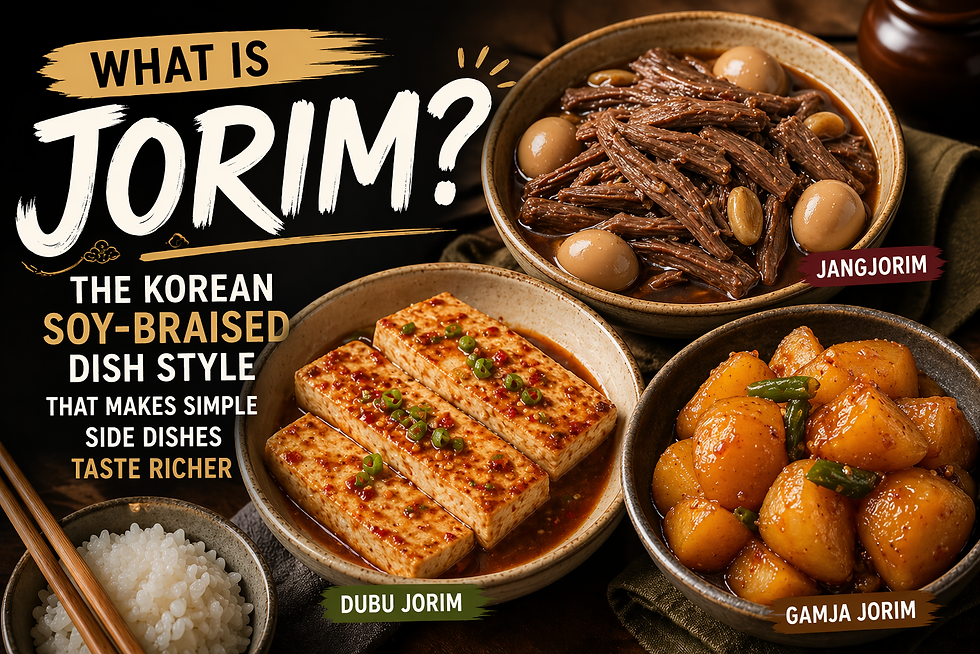
Jorim is the braised lane that often reduces into a tighter, more concentrated sauce. It usually feels more compact, more soy-driven, and more side-dish shaped. The ingredient still holds itself a bit more firmly.
Jjim usually feels broader, softer, and more moisture-heavy.
The sauce or steaming environment is there to create tenderness, not just reduction. Even when jjim dishes are richly seasoned, they often feel less tight and more yielding than jorim. That is why galbi jjim and gyeran jjim do not feel anything like jangjorim even though all three belong somewhere in the larger braised-simmered conversation.
If jorim often tastes concentrated, jjim often tastes enveloping.
How jjim feels different from jjigae
This is the other comparison that helps fast.
Jjigae is stew. It is built around the bubbling liquid as a central part of the meal.
Jjim is not mostly about the broth.
Even when moisture is essential, jjim usually feels like the liquid exists to soften and settle the ingredients rather than to become a bowl you spoon like soup. That is why sundubu jjigae and gyeran jjim can both feel warm and comforting, but in completely different ways. One is broth-forward. The other is texture-forward.
That difference matters when you are trying to understand what kind of comfort you are actually craving.

Why jjim works so well as comfort food at home
Jjim is the kind of style that rewards slowing down just enough.
That makes it especially useful for meals where you want more than quick flavor. It gives the table softness. It gives the meal weight. It makes rice feel necessary in the best way because there is always something rich, tender, or spoonable to pull against.
It also tends to reheat well and sit well, which helps. A lot of jjim dishes are not fragile. They are built to hold onto their comfort.
That is one reason they stay memorable. The dish is not only good in the first few hot minutes. It often stays good because the whole point was already depth and tenderness, not crispness.
What usually goes into a jjim dish
There is no single universal formula, but many jjim dishes share a familiar structure.
A main ingredient that benefits from softening. Enough liquid or steam to keep the cooking gentle and moist. Aromatics or sauce components that deepen over time. Patience long enough for the dish to relax.
In meatier jjim, soy sauce, garlic, sweetness, stock, sesame oil, and vegetables often show up. In steamed egg jjim, the structure is much simpler, but the goal is still tenderness. In vegetable jjim, moisture and time bring sweetness and softness forward.
The point is not one flavor profile.
The point is tenderness as a cooking goal.
Why dangmyeon often makes sense in jjim
This is one of the small details that helps the style click.
Korean glass noodles, or dangmyeon, often show up in jjim dishes like galbi jjim because they behave well in that kind of cooking environment. They absorb flavor, catch sauce, and still keep some chew instead of dissolving into softness right away.
That is why a product like Wang Korean Starch Noodle fits so naturally here. MyFreshDash describes it as a sweet potato starch noodle that holds up well in saucy dishes and soaks in flavor without getting soggy, which is exactly what you want when dangmyeon is finishing inside a deeper braised jjim.
That is why they work so naturally in deeper braised dishes. They pick up the comfort without disappearing into it.
Is jjim beginner-friendly?
Yes, especially once the word stops sounding technical.
The cooking logic is very approachable. You are making food softer, more tender, and more fully flavored than it was at the start. That is not a hard idea to like.
It is also a very useful Korean style word to know because it tells you a lot about what kind of meal you are about to get. Once you understand jjim, you stop reading it as a random syllable in a dish name and start reading it as a comfort cue.
That helps with menus, grocery decisions, and choosing dishes that fit your appetite better.
Why the word matters beyond one steamed egg dish
This is what makes jjim worth learning as a category.
If you only know gyeran jjim, that is useful. But once you understand jjim as the Korean tenderness-driven style behind steamed eggs, braised short ribs, vegetable dishes, and other soft comfort foods, you start seeing a bigger pattern in Korean cooking.
Muchim brings freshness.
Bokkeum brings pan-built immediacy.
Jorim brings tighter concentration.
Jjim brings softness that has had time to arrive.
That is why the word matters. It explains a whole lane of Korean comfort food in one move.
👉 Browse our [Korean Recipes] for more options.
Final bite
Jjim is the Korean braised-and-steamed comfort style behind dishes that feel soft, moist, and fully settled by the time they reach the table.
Not because they are bland.
Because they have given up edge in favor of tenderness.
That is why galbi jjim, gyeran jjim, and other jjim dishes can feel so satisfying even when they are very different foods. The comfort is built into the texture first.
Once you know that, the word stops looking abstract and starts telling you exactly what kind of meal is on the way.
Related posts to read next
FAQ
What does jjim mean in Korean food?
Jjim refers to a Korean cooking style where ingredients are steamed, braised, or cooked with enough moisture that tenderness and softness become the point.
Is jjim always braised?
Not always. Some jjim dishes are more steamed than braised, like gyeran jjim. The bigger idea is moist, tender cooking rather than one exact technique.
Is gyeran jjim in the same category as galbi jjim?
Yes. They are very different foods, but both fit the jjim style because softness, moisture, and comfort are central to how they are cooked and how they eat.
How is jjim different from jorim?
Jorim usually feels tighter and more reduced, while jjim usually feels softer, broader, and more moisture-driven. Jjim is usually more about tenderness than concentration alone.
How is jjim different from jjigae?
Jjigae is stew and tends to be broth-forward. Jjim uses moisture too, but the focus is usually on softening and settling the ingredients rather than building a bowl around broth.
What foods are commonly made into jjim?
Eggs, short ribs, chicken, vegetables, seafood, and other ingredients that benefit from moist, gentle cooking are common choices.
Why does jjim feel so comforting?
Because the texture is usually soft, tender, and fully settled. The dish feels like the ingredients had time to relax into the cooking, and that changes the whole mood of the meal.

Comments